
Backrooms
A ReidsonFilm extra: We all have our loops

Directed by Kane Parsons
USA & Canada, 2026
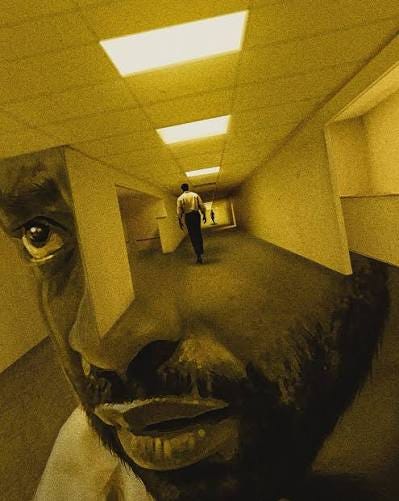
In which one of ReidsonFilm goes on a bit of a tangential mad one…
‘Liminal’ is a term we use from time to time at ReidsonFilm, to describe a place or scene that evokes a particular feeling – a concept born out of the internet aesthetic known as “liminal spaces”. It’s difficult to describe exactly what qualifies as a liminal space, so the best thing to do is look at some examples yourself. To give a sense of just how prolific the phenomenon has become, take a look at the /r/LiminalSpace subreddit, where over a million users regularly post images of liminal spaces they encounter in the world around them.
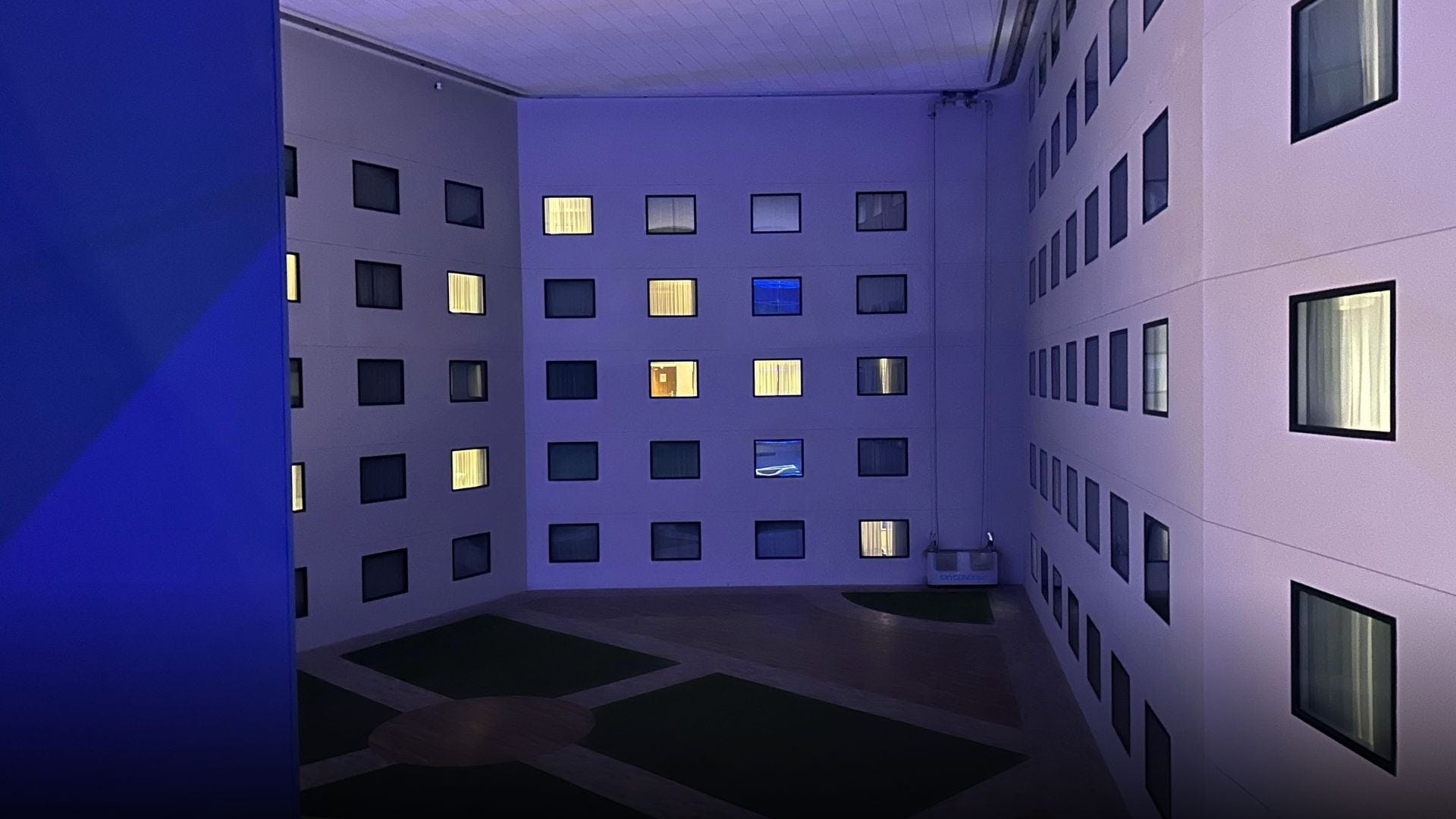
The term ‘liminal’ derives from the Latin limen meaning “threshold”. A liminal space is often an in-between space: a threshold between somewhere and somewhere else. It can also be a metaphorical or temporal in-between state where one is finding the space at the “wrong time” – an empty school or a shopping centre after closing, a place that usually feels busy but is strangely empty. These spaces create a feeling akin to eeriness or the uncanny, but with a sense of dreamlike familiarity: somewhere that you feel you’ve been before, but it’s not quite the same.
It’s a notoriously difficult aesthetic to define, but liminal spaces have been with us for a long time (the concept of liminality apparently dates back to 1884). In fact, many of our favourite filmmakers have made extensive use of them. The Overlook Hotel in The Shining and the Black Lodge featured in Twin Peaks both textbook examples of these eerie, dreamlike, between-spaces. Indeed, you could argue that almost anything David Lynch touched belongs somewhere in the liminal canon.
The internet aesthetic of liminal spaces really came to prominence, however, after a now infamous 4chan¹ post which depicted this image:
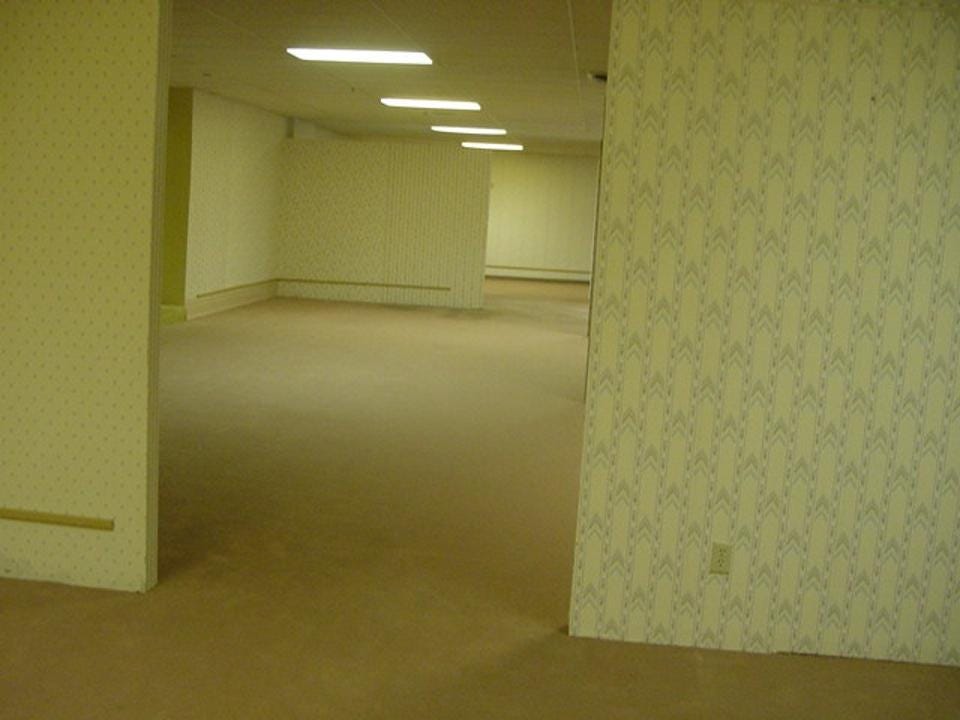
Accompanying the image was the caption:
“If you’re not careful and you noclip out of reality in the wrong areas, you’ll end up in the Backrooms, where it’s nothing but the stink of old moist carpet, the madness of mono-yellow, the endless background noise of fluorescent lights at maximum hum-buzz, and approximately six hundred million square miles of randomly segmented empty rooms to be trapped in. God save you if you hear something wandering around nearby, because it sure as hell has heard you…”
The emergence of the Backrooms spawned a new wave of online interest in liminal spaces. The Backrooms soon became a canonised liminal universe, with fans further theorising and expanding the backrooms with additional levels, and entities. Unaware of this growing fan community, a 16-year-old named Kane Parsons independently decided to make a short film inspired by the original image after stumbling across it online. The film rapidly went viral on YouTube, and Parsons turned the initial idea into a web series.
Four years later, the series had amassed over 197 million views, and so it is no surprise that A24 – alongside several other studios – saw feature-film potential in the concept.
Backrooms works within the continuity and lore established by the original series, but its central character is Clark (Chiwetel Ejiofor), a disaffected furniture salesman and would-be architect struggling through a divorce with the help of therapist Dr Mary Kline (Renate Reinsve). After spending a late night drinking and watching TV from the comfort of one of his discount beds, Clark discovers an entrance to the Backrooms in the furniture store’s basement. With his architectural interest piqued and his furniture store seemingly short on customers, he becomes increasingly drawn to exploring the mono-yellow corridors, mapping them piece by piece, room by room.
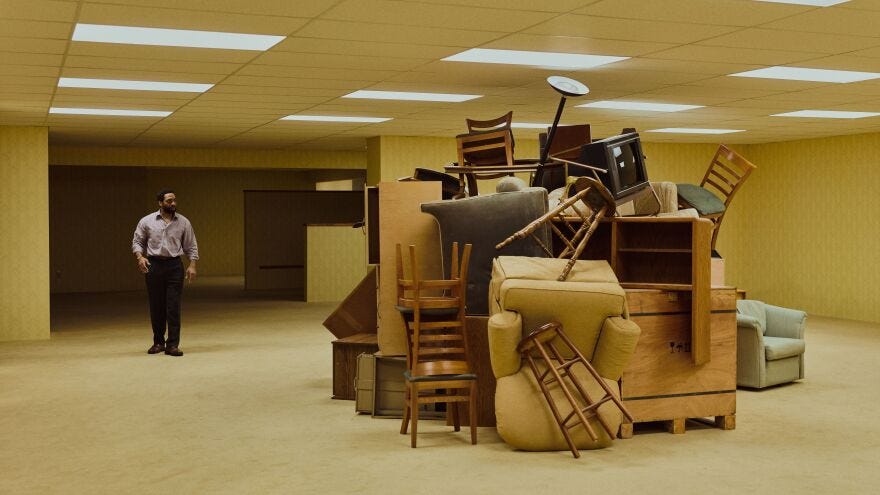
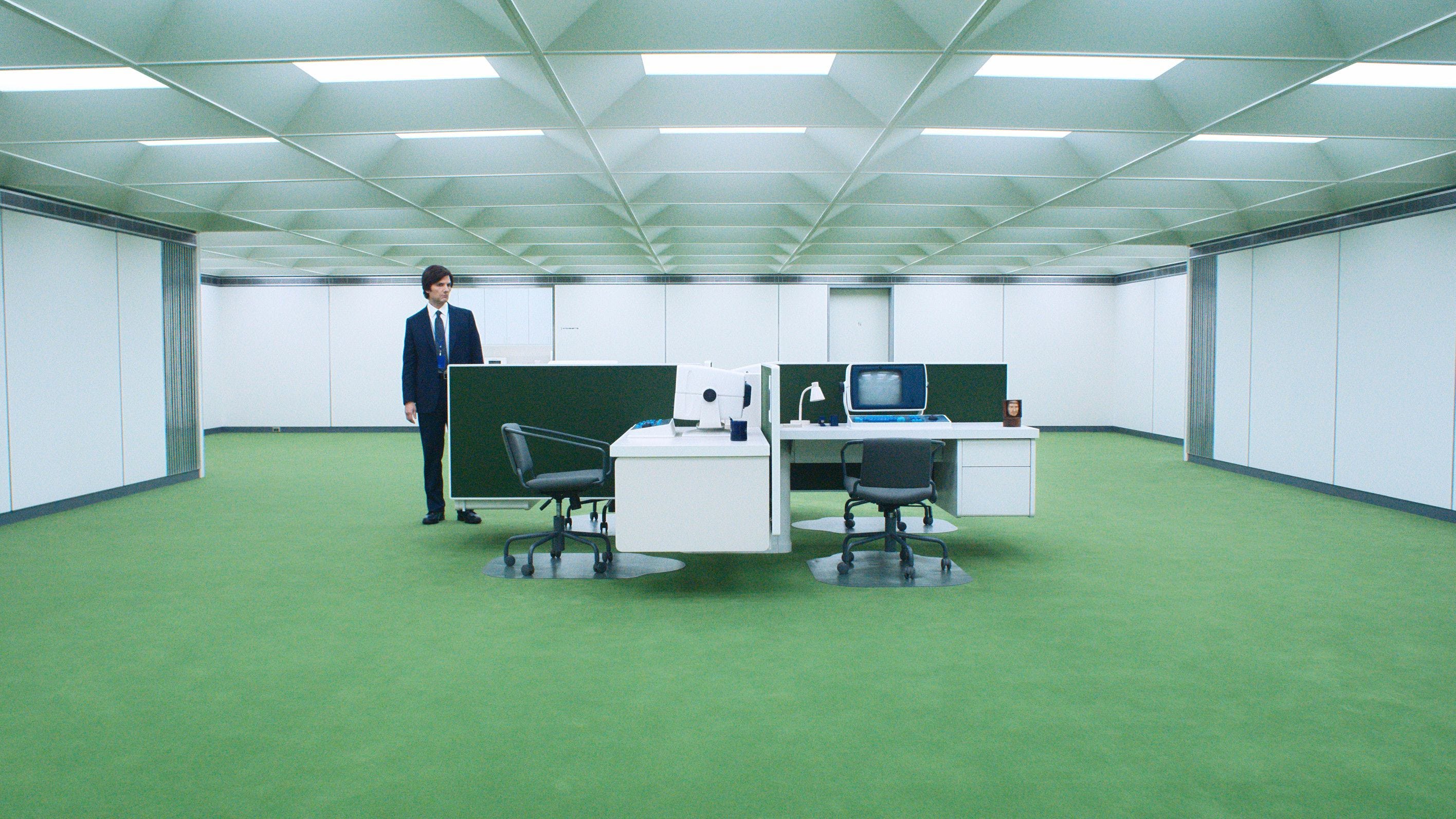
Backrooms does an excellent job at capturing the essence of this unique, terminally online genre in the feature-length format. This may not come as a huge surprise, seeing as Kane Parsons himself directs the film (while only 20 years old he is an undisputed veteran of the Backrooms project). And while the original web series was largely rendered using digital software, the A24 production team claims to have built over 30,000 square feet of actual backroom for the set. There’s no doubt this would have helped immerse the cast – Ejiofor in particular – in the world they were asked to inhabit.
The seemingly endless yellow wallpaper and surreal, angular set designs at times recall the mind-bending superstructures of an M.C. Escher painting. As a result, the film remains captivating even when very little is actually “happening” on screen. The smooth edges and pale fluorescent lights of Backrooms are at once unsettling and hypnotic.
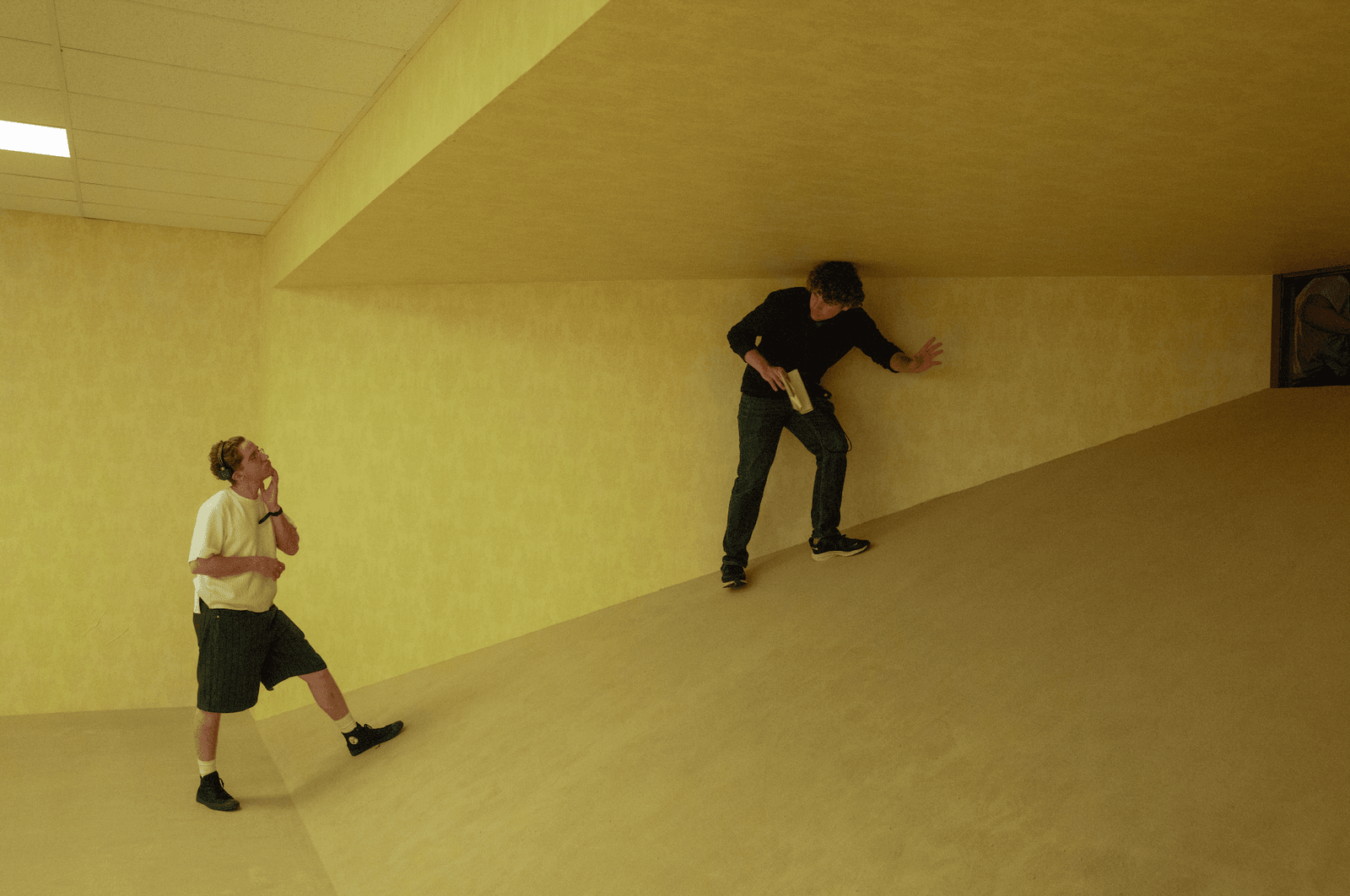
The film does not, however, shy away from putting its own philosophical stamp on the well-established Backrooms universe. While the wider Backrooms canon often leans heavily on the presence of mysterious “entities” hiding around unseen corners (this film being no exception), Parsons broadens the scope to encompass a wider range of existential fears.
As the film goes on, we discover that the Backrooms are not mind-independent physical spaces, but in fact exist as a kind of dark manifestation of ourselves: an upside-down world sustained by the vague memories and unresolved trauma of its visitors. This becomes apparent when projections of the real world begin to surface in twisted, uncanny ways through the labyrinth. Half a sign from Clark’s furniture store, a pile of identical sofas, and a red stop sign, all emerge in dreamlike forms. This idea of the Backrooms as a kind of unconscious “memory palace” is reaffirmed when we learn that a mysterious organisation Async – formally known for making MRI scanners – has begun conducting research within them.
The psycho-spatial dimension of Backrooms also resonates with the film’s central relationship, namely that of Clark and Mary as patient and therapist. Through their sessions we gain insight into Clark’s grievances, his anxieties, his flaws. These revelations explain both why Clark is drawn to the Backrooms and the traumas he is projecting into them.
Mary’s surname is Kline, which immediately brought to mind the Klein Bottle – a closed, non-orientable surface in mathematics similar to a Mobius strip which, if you were to travel along its surface, would eventually return you to your starting point. This has a particular resonance with the experience of wandering through the Backrooms, accentuated by one of Mary’s recurring observations:
We all have our loops. Our habits. Behaviours that keep us walking in circles. Reaching for the same solutions over and over again. Thinking each time they will take you somewhere new, but they don’t. And still, it’s the neural pathway of least resistance. A path you made. It’s the one that kept you safe when you were a child. You learned to push people away before they could hurt you. And now, as an adult, you’re still stuck right where you started. Alone.
This is one of the film’s most revealing moments.
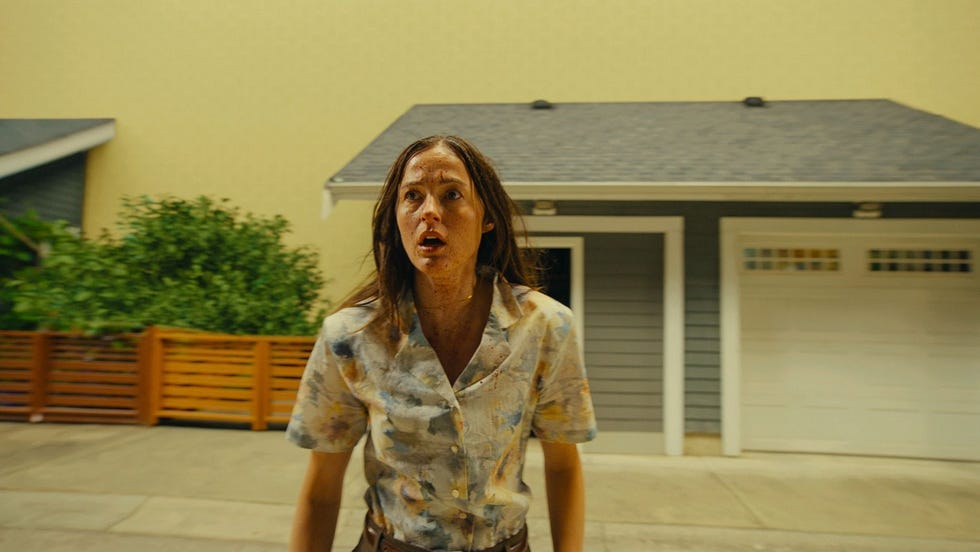
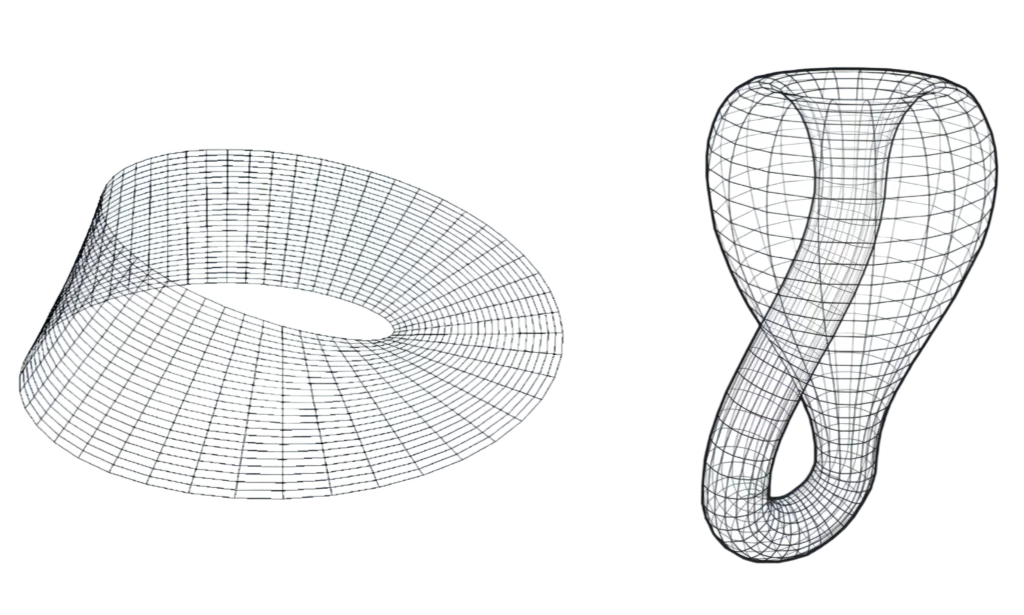
Once Mary begins to experience the Backrooms for herself, we realise that they represent not only Clark’s traumas, but hers as well. In this sense, the film frames the Backrooms as a kind of collective unconscious in the Jungian tradition: a metaphysical canvas inscribed with the symbols and ideas of its human subjects, allowing them to explore the darkest recesses of their mind and their relationships with each other. If that wasn’t enough psychoanalytic messaging, later we also find Clark reckoning with something not entirely dissimilar to a shadow self. The Freudians among our readers may find comfort in the fact that the film ultimately rejects the notion that one’s inner shadow can be neatly confronted or reconciled with. In a rather strange climax, Clark tries to appease his abhorrent Backrooms doppelganger, only to realise too late that this is an impossible task. No therapeutic practice can ‘open the window within’, as Dr Mary Kline would have it, some monsters are best left behind closed doors.
So what is Backrooms trying to tell us, if not encourage us to battle our demons head-on? The film does an impressive job of weaving together a number of socio-political ideas, some of which have already been explored by the enthusiasts of liminal spaces and what they reveal about contemporary culture. Many of the recurring images that emerge throughout the Backrooms relate to slogans, branding and consumerism. We find Nike trainers, a ‘discount’ sign, a large glowing Christmas tree – all clearly reflective of Clark’s real-world struggles. In the outside world, we witness him working a job he hates, struggling to keep his business afloat in a brutally competitive economy with very few customers. At one point he is reduced to filming a faintly humiliating TV ad with the help of his equally disaffected employees.
The Backrooms appear to reflect the way the human mind recalls and regurgitates slogans, jingles and brands often in dark, distorted fragments, as it is relentlessly bombarded by the consumer culture of late-stage capitalism. Shackled by decades of advertising and by the promise of a brighter future that seems to be vanishing over the horizon, this concept was articulated best by Mark Fisher, who famously described how modern society is haunted by the ‘lost futures’ promised by 20th century media culture. Backrooms functions as a physical manifestation of that collective loss.
This theme also features prominently in the work of artists such as Boards of Canada and The Caretaker, who both feature in the film’s soundtrack, as well as Oneohtrix Point Never, one of the figures most closely associated with Vaporwave music – often regarded as an aesthetic sibling of liminal spaces.
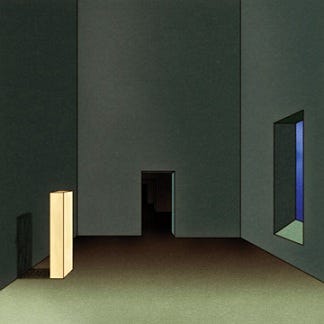
Fisher also describes the way capitalism erodes the distinctiveness of geography, replacing it with an expanding world of uncanny “non-places”, a concept coined by another Mark: Marc Augé. Most of us have visited countless shopping centres, two-star hotel chains, fast-food branches, or petrol stations. They are all identical, yet subtly different in ways that are difficult to articulate. Have you been to this exact Burger King before? Or was it another one? Deja vu? A glitch in the matrix? The radicality of the Backrooms lies in their positioning as the ultimate ‘non-place’ of capitalism, the final boss of simulacra, the copy of a copy of a copy ad infinitum, a geographical Waluigi² if you will.

Similarly, Backrooms contains a cautionary tale about the deregulation of digital commons lurking within its hallways. The Backrooms are a realm of infinite possibility, with a wondrous ability to reflect ideas and experiences back at us in ways we could never have conceived, albeit often in sinister forms: a clear resonance with the current AI boom. Another unfortunate similarity is that both the Backrooms and the world of Frontier AI increasingly appear to be monopolised and gate-kept by shadowy megacorporations claiming to be acting in the public interest. Like any new discovery or technology, with the Backrooms there are positive and negative implications. Ultimately their lasting impact will be determined by the moral character of those who find themselves in control of them.
More than much of the surrounding online culture and fan fiction, Parson’s film pulls back from a simple haunted-house horror and allows space to contemplate the real demons that haunt modern life, gesturing toward the larger systemic and collective anxieties, while never losing sight of the damage these forces have on the individual trying to survive the modern world.
As I’ve now demonstrated, it’s very easy to become carried away with interpretations of Backrooms or mired in its theoretical implications. For a debut film from a twenty-year-old director, its depth and sophistication are astonishing. But what really makes the film a success is that for the hour and forty-five minutes you spend watching it, all of that intellectual scaffolding goes out of the window. Backrooms is a genuinely immersive experience that seeps into your mind and under your skin – you can enjoy it just as much as you can analyse it.
And you will analyse it. The film leaves plenty of unanswered questions, unsolved mysteries and easter eggs in its wake. It certainly warrants a second viewing (After all, we all have our loops). Just don’t spend too long in the bathroom on your way out. One wrong turn and who knows where you might end up…
4chan - an anonymous message board website where people post images and messages
Waluigi - a fictional video game character from Nintendo’s Mario series who is Luigi’s tall, mischievous rival
Thank you for reading Reids on Film. If you enjoyed our review please share with a friend and do leave a comment.
I analyzed this film on my channel and shared my theory, and I'd be happy if you discussed it with me and read my article. Thank you.